

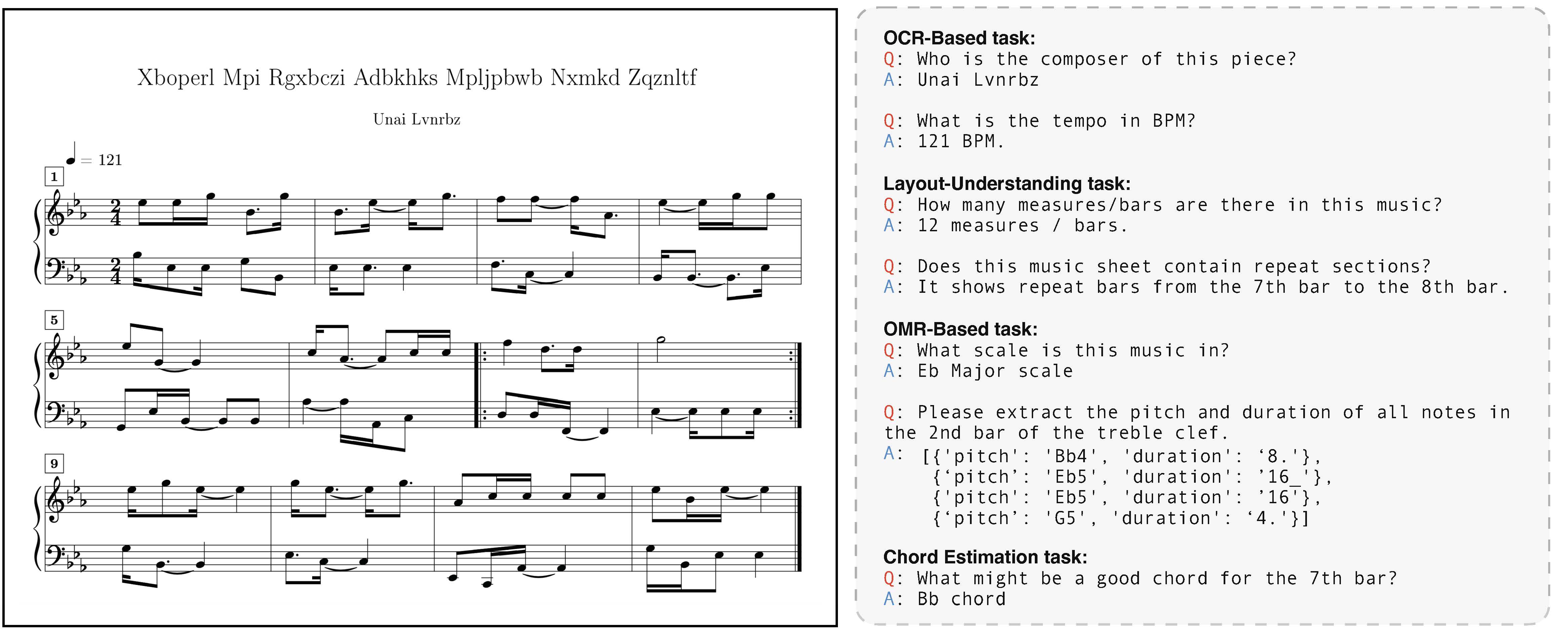
MusiXQA is a multimodal dataset for evaluating and training music sheet understanding systems. Each data sample is composed of:
- A scanned music sheet image (
.png) - Its corresponding MIDI file (
.mid) - A structured annotation (from
metadata.json) - Question–Answer (QA) pairs targeting musical structure, semantics, and optical music recognition (OMR)
📂 Dataset Structure
MusiXQA/
├── images/                # PNG files of music sheets (e.g., 0000000.png)
├── midi.tar               # MIDI files (e.g., 0000000.mid), compressed
├── train_qa_omr.json      # OMR-tasks QA pairs (train split)
├── train_qa_simple.json   # Simple musical info QAs (train split)
├── test_qa_omr.json       # OMR-tasks QA pairs (test split)
├── test_qa_simple.json    # Simple musical info QAs (test split)
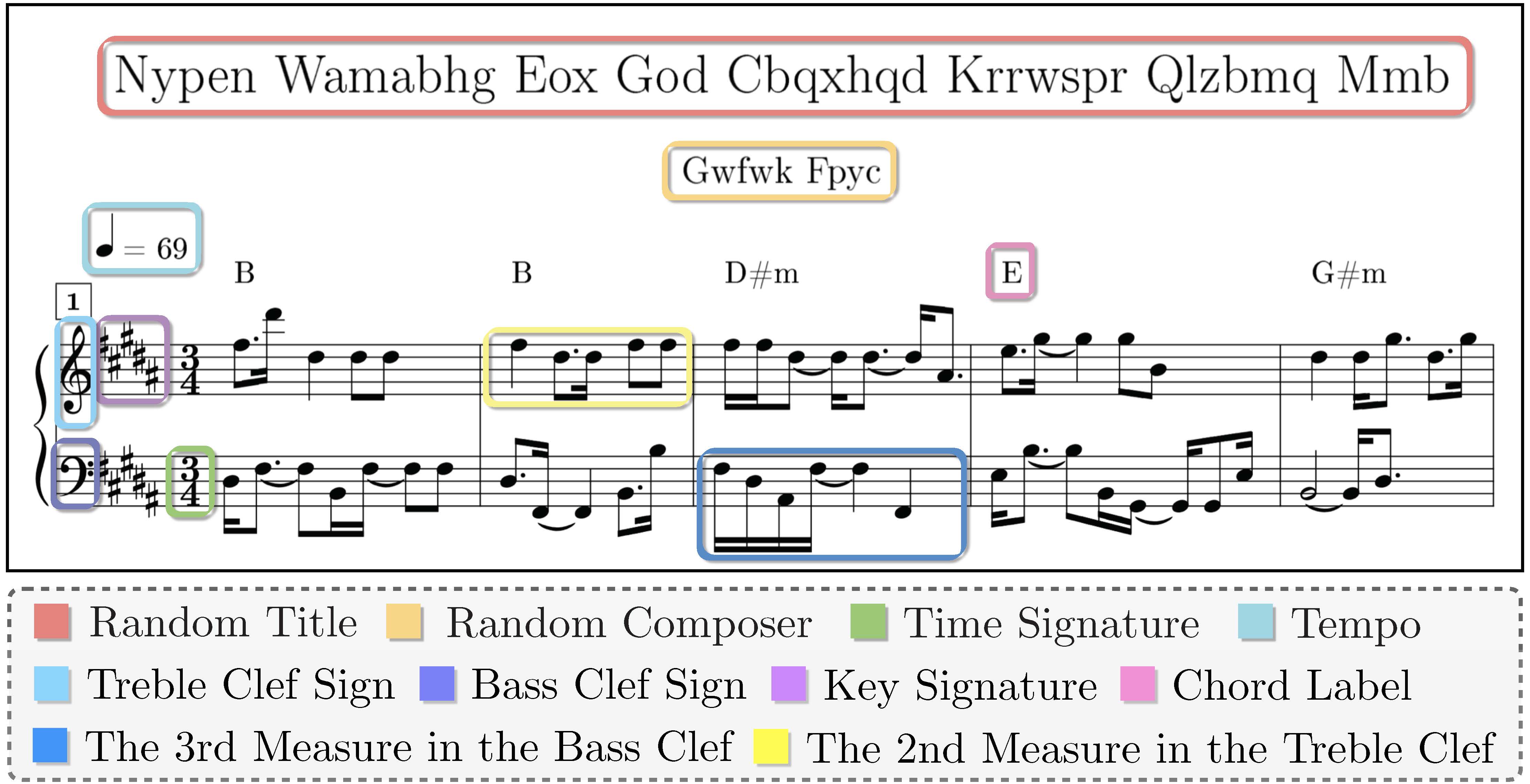
├── metadata.json          # Annotation for each document (e.g., key, time, instruments)
🧾 Metadata
The metadata.json file provides comprehensive annotations of the full music sheet content, facilitating research in symbolic music reasoning, score reconstruction, and multimodal alignment with audio or MIDI.
❓ QA Data Format
Each QA file (e.g., train_qa_omr.json) is a list of QA entries like this:
{
  "doc_id": "0000001",
  "question": "What is the title of the music sheet?",
  "answer": "Minuet in G Major",
  "encode_format": "beat"
}
• doc_id: corresponds to a sample in images/, midi/, and metadata.json • question: natural language query • answer: ground truth answer • encode_format: how the input is encoded (e.g., "beat", "note", etc.)
🎓 Reference
If you use this dataset in your work, please cite it using the following reference:
@article{chen2025musixqa,
  title={MusiXQA: Advancing Visual Music Understanding in Multimodal Large Language Models},
  author={Chen, Jian and Ma, Wenye and Liu, Penghang and Wang, Wei and Song, Tengwei and Li, Ming and Wang, Chenguang and Zhang, Ruiyi and Chen, Changyou},
  journal={arXiv preprint arXiv:2506.23009},
  year={2025}
}